Your first nail-art attempt does not need to look like a miniature painting. In fact, the designs that appear most polished are often built from only one controlled detail: a dot, a line, a narrow tip, a small sticker, or a soft fade.
The difference between a manicure that looks intentional and one that feels unfinished is usually not artistic talent. It is repetition, spacing, clean edges, and knowing when to stop adding more.
The beginner rule that changes everything: choose a design that you can repeat with your less-coordinated hand.
A complicated flower that looks beautiful on the first hand but impossible on the second is not a beginner-friendly design. One small accent repeated neatly across both hands will usually create a stronger final result.
This guide uses regular nail polish as the main learning system because mistakes can be corrected without curing each layer. The same visual ideas may later be adapted to gel, press-ons, or salon services when the products are used correctly.
What Makes Beginner Nail Art Look Professional?
A professional-looking beginner manicure has a clear idea that can be understood immediately. The viewer can see where the accent begins, why it is placed there, and how it connects to the other nails.
Small variations are normal because natural nails are not identical. The goal is consistent proportion—not ten perfectly duplicated drawings.
A small space between polish and skin creates a neater result than color flooding the cuticle.
Dots and lines should sit in approximately the same area on each nail.
One base color and one detail color are enough for many successful designs.
A smooth top coat connects the artwork and reduces the appearance of small texture differences.
Use distance as a test. Place your hand on the table and look at it from normal conversation distance. If the design feels balanced from there, tiny differences visible only from a few centimeters away are usually not important.
A Beginner Kit Without Unnecessary Tools
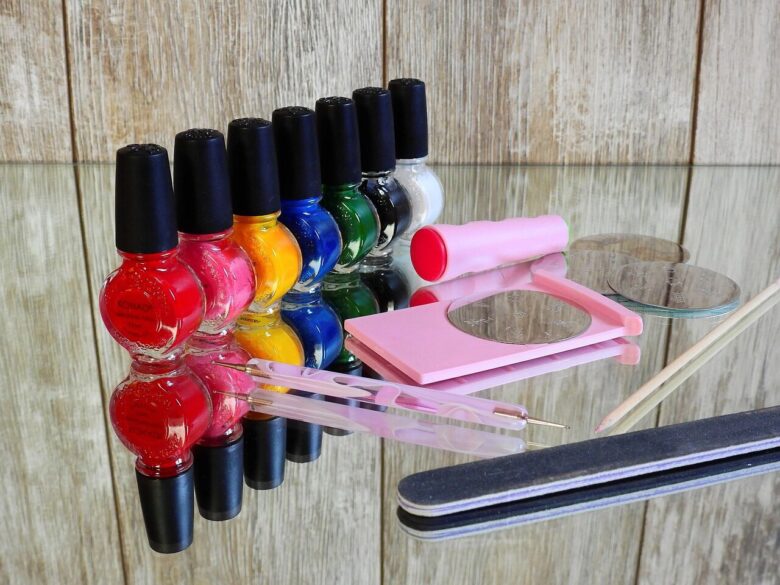
You can complete most projects in this guide with ordinary manicure supplies and one or two inexpensive art tools.
Start with these eight items
Optional extras include striping tape, a small makeup sponge, nail stickers, glitter polish, a silicone mat, and practice tips.
You do not need an electric file, professional drill bits, acrylic products, builder gel, or extension supplies to learn dots, tips, lines, and simple color blocks.
For a broader explanation of basic equipment, visit our guide to at-home manicure tools.
Choose the Right Difficulty Level
Choose one dot, sticker, stripe, or colored corner. Nothing needs to be drawn repeatedly across the nail.
Create a row of dots, French tip, small flower, or repeated accent that requires basic spacing.
Use tape, a sponge, or a detail brush to create negative space, waves, fades, or two-color shapes.
Do not begin at Level 3 simply because the finished picture looks more impressive. A clean Level 1 design teaches polish control, spacing, and top-coat application without creating unnecessary frustration.
Ten Easy Nail Art Projects That Look Intentional
The Single Cuticle Dot
A small accent with almost no drawing
- One base color
- One contrast color
- Small dotting tool
Apply the base color and allow it to dry. Place one tiny dot near the center of the cuticle area, leaving a visible margin between the dot and the skin. Repeat the placement on every nail.
Use the same tool and similar pressure each time. Reload the tool before every dot rather than continuing until the polish disappears.
The Vertical Dot Row
A simple design that adds visual length
- Clear or neutral base
- Small dotting tool
- One dark or metallic color
Place three small dots in a straight vertical line from the cuticle area toward the center of the nail. Start with the middle dot, then place one above and one below it.
When one dot becomes too large, enlarge the others slightly instead of repeatedly touching the largest one. Stop before the row becomes crowded.
The Five-Dot Flower
A recognizable design made without freehand drawing
- Neutral base color
- Medium dotting tool
- Two detail colors
Place five dots in a small circle. Allow them to settle, then add a smaller contrasting dot in the center. Use the flower on one or two accent nails rather than every nail.
You only need to complete the detailed design twice per hand. Paint the remaining nails with the base color or one small dot.
The Diagonal Color Block
A straight-edged design that does not need symmetry
- Base color
- Contrast color
- Striping or manicure tape
Allow the base color to dry completely. Place tape diagonally across the upper third of the nail, paint the exposed corner, and remove the tape while the new color is still workable.
Do not place tape over soft polish. It may pull away the base layer and create a rough edge that is difficult to repair cleanly.
The Micro French Tip
A narrow line designed for short or natural nails
- Sheer base color
- Fine detail brush
- Tip color
Use a fine brush to follow the natural free edge. Begin with a line thinner than the final result. Make small corrections only after checking all ten tips from normal viewing distance.
A slightly diagonal or side French tip is easier than a perfectly centered smile line because small differences appear more intentional.
The Side French
A curved accent that starts from one corner
- Clear or sheer base
- Regular polish brush
- Cleanup brush
Place the color brush near one side of the free edge and sweep diagonally toward the center. Repeat the angle across the manicure instead of trying to create identical curves.
Use a small brush lightly dampened with remover to sharpen the lower edge. Correct the shape rather than adding more polish over it.
The Negative-Space Half Moon
A clean cuticle detail without painting the full nail
- One opaque polish
- Round guide stickers
- Base and top coats
Apply base coat and let it dry. Place a round guide near the cuticle so only part of the sticker sits on the nail. Paint above it, then remove the guide before the color becomes completely dry.
Keep the exposed half moon similar in depth. It does not need to match the natural lunula beneath the nail.
The Single Fine Stripe
A graphic detail with one controlled movement
- Base color
- Long fine brush
- Contrast polish
Rest both hands on the table. Load only the tip of the brush, place it near the cuticle area, and pull toward the free edge in one slow motion. Rotate the finger slightly rather than moving the brush in several directions.
Draw three lines on a plastic surface or practice tip before touching the manicure. This reveals whether the polish is too thick or the brush is overloaded.
The Minimal Sticker Accent
Detailed artwork without painting the image yourself
- Dry base color
- Small nail stickers
- Top coat
Use tweezers to lift a small sticker without touching the adhesive excessively. Place it away from the skin and free edge, press all corners flat, and seal it after confirming that nothing is raised.
The base may still be soft, the sticker may be too large for the curved nail, or an edge may extend into the cuticle or sidewall.
The Soft Glitter Fade
A forgiving design that hides an imperfect tip line
- Base color
- Fine glitter polish
- Small sponge or polish brush
Place the highest concentration of glitter at the free edge. Use the nearly empty brush or sponge to carry a smaller amount toward the center of the nail.
Build the glitter gradually. One heavy coat may create a thick ridge and cover the base color instead of producing a transition.
Which Designs Work Best on Short Nails?
Short nails do not need tiny versions of every design created for long extensions. They often look strongest with details that preserve open space.
| Design | Why it works on short nails | What can make it feel crowded |
|---|---|---|
| Single cuticle dot | Uses almost no surface area | Several large dots on every nail |
| Micro French tip | Defines the free edge without covering much length | A deep tip that occupies a large part of the nail |
| Vertical stripe | Directs the eye from the base toward the tip | A wide line that divides the nail into heavy sections |
| Side French | Adds movement while leaving most of the base visible | Using several colors and a deep diagonal section |
| One small sticker | Provides detail without requiring nail length | A decal wider than the central area of the nail |
| Fine glitter fade | Creates shine without a sharp border | Large glitter pieces covering the full nail |
For more design combinations built around practical lengths, read our guide to short nail designs.
How to Handle the Less-Coordinated Hand
Most tutorials show the artist working with the dominant hand. Your actual difficulty appears when you need to reverse the process.
Paint the difficult hand first
Use your less-coordinated hand while you are still patient and before the other hand has wet polish that may be smudged.
Move the finger, not only the brush
For French tips and lines, keep the brush relatively stable and rotate the finger beneath it.
Rest every part of the hand
Keep both elbows on the table and support the painting hand with the side of the palm or little finger.
Use fewer detailed nails
Complete a detailed accent on the thumb or ring finger and use simple dots or solid color on the others.
Choose forgiving shapes
Diagonal blocks, side tips, soft waves, glitter fades, and stickers hide small differences better than identical portraits or lettering.
Correct after both hands are finished
Do not repeatedly interrupt the design to fix tiny differences. Complete the set, compare it, and correct only what is clearly distracting.
A useful simplification: the two hands need to belong to the same design family, but they do not need to be exact copies. One hand can use dots while the other uses small flowers made from the same colors.
A 30-Minute Beginner Manicure
The actual drying time may extend beyond 30 minutes, but the active design process can remain short when the plan is simple.
Shape and prepare
Remove old polish, smooth snags, wash and dry the hands, then remove visible dust and oil from the nail plate. Avoid aggressive surface buffing.
Apply base coat
Use one controlled layer and keep it away from the surrounding skin.
Build the base color
Apply two thin coats when needed. Leave time between them rather than creating opacity with one heavy layer.
Add one art element
Complete the dots, stripe, sticker, tip, or glitter fade. Avoid introducing another technique simply because extra colors are available.
Clean the margins
Use a small brush lightly dampened with remover. Work around the sidewalls and cuticle line without flooding the skin.
Apply top coat
Wait until the art has settled, then float the brush lightly over the design. Continue protecting the manicure while the deeper regular-polish layers harden.
Cleanup Is Part of the Design
A clean margin can improve the manicure more than adding another decoration.
Use a small angled or rounded brush with a minimal amount of remover. Wipe the brush on a pad after each correction so old polish is not spread around the skin.
Remove only the polish that is clearly outside the intended edge. Repeatedly tracing the cuticle line may create an unnecessarily large gap.
A cotton swab can clean larger mistakes, but it is often too wide for precise work beside the sidewalls. A small brush provides more control.
How to Fix Common Nail Art Problems
Allow it to settle, then make the remaining dots slightly larger. Do not keep pressing the oversized dot in an attempt to reduce it.
Turn it into a soft wave, widen it slightly, or use a cleanup brush to refine one edge. A deliberate curve looks better than an overworked straight line.
Remove part of the lower edge with a detail brush and remover. Avoid adding more base color over wet tip polish.
Press it flat before top coat. When the sticker does not follow the nail curve, replace it with a smaller design.
Allow the first coat to set and add another thin layer. Repeatedly brushing wet polish usually creates more streaks.
Allow more drying time and use a fuller top-coat brush that can float over the artwork without dragging it.
Make it the accent nail intentionally. Add one small related detail to the corresponding nail on the other hand.
Remove details from one or two nails and replace them with the solid base color. Empty space helps the remaining art stand out.
Create a Design Plan Before Opening the Polish
Beginner nail-art planning card
Choose one main technique. A manicure with dots, French tips, flowers, chrome, tape, glitter, and stickers may contain many good ideas but lack a clear focus.
A Simple Color Formula
Beginners do not need advanced color theory. Use one of these combinations:
Examples include nude with black, beige with red, milky pink with navy, or clear with white.
Combine pale pink with burgundy, light blue with navy, lavender with plum, or beige with chocolate.
Use nude with gold, black with silver, brown with bronze, or milky white with pearl.
When the contrast feels too strong, replace bright white with cream, black with brown, or a vivid color with a muted version.
Our guide to choosing nail colors for different skin tones and occasions provides more ways to compare shades without treating color rules as restrictions.
Practice Without Repainting All Ten Nails
Learning becomes faster when each practice session has one clear target.
Useful practice
- Draw dots on a plastic lid or silicone mat.
- Practice lines on clear artificial tips.
- Test the design on one thumb first.
- Compare two brush sizes.
- Repeat one technique for several manicures.
Practice that creates frustration
- Trying five new techniques in one manicure.
- Changing the design after every imperfect nail.
- Using thick, old polish for fine details.
- Comparing your first attempt with edited close-up photographs.
- Filing or removing the manicure repeatedly in one day.
How to Make Simple Nail Art Last Longer
- Begin with clean, completely dry nails.
- Keep hand cream and cuticle oil off the nail plate immediately before polishing.
- Apply base color in thin layers.
- Allow tape to touch only dry polish.
- Keep stickers away from the skin and free edge.
- Wait before applying top coat over dots and lines.
- Seal the surface without pressing the brush into the design.
- Wear gloves for dishes and household cleaning.
- Use tools instead of nails to open packages and lift labels.
- File a snag rather than pulling it.
Regular polish may feel dry on the surface before the lower layers have completely hardened. Avoid hot water, tight gloves, bedding pressure, and demanding handwork immediately after finishing.
For detailed advice about formulas and wear, read How to Choose the Best Nail Polish for Long-Lasting Results.
Regular Polish, Gel, Stickers, or Press-Ons?
| Method | Why a beginner may choose it | Main consideration |
|---|---|---|
| Regular polish | Mistakes can be corrected with remover and no curing lamp is required | Needs drying time and may smudge before fully hardened |
| Gel polish | Each finished layer remains in place after correct curing | Requires compatible products, lamp curing, skin-safe application, and careful removal |
| Nail stickers | Create detailed images without freehand drawing | Edges must sit flat and remain away from skin |
| Press-on nails | Provide a complete design without painting both hands | Correct sizing, adhesive use, comfort, and removal still matter |
| Salon nail art | Useful for intricate work, extensions, events, or unfamiliar products | Confirm the service, price, maintenance, and removal method first |
Using gel as a beginner
Gel allows you to cure one stage before beginning the next, but it is less forgiving when uncured product repeatedly touches the skin. Follow the product system’s instructions and remove any gel from the surrounding skin before curing.
Use a compatible lamp and do not assume that extra curing time corrects thick layers or incompatible products. Gel should also be removed through the appropriate method rather than peeled away.
Protect the skin during gel curing
The American Academy of Dermatology recommends applying broad-spectrum, water-resistant SPF 30 or higher to the hands before a gel manicure. Dark, opaque fingerless gloves designed for nail-lamp use are another option.
Nail Art Safety Basics
Read product labels and follow the directions and warnings for polish, remover, glue, gel, top coat, nail hardener, and decorative products.
Use nail products with appropriate ventilation and keep flammable products away from cigarettes, candles, flames, pilot lights, and other heat sources.
Do not cut deeply into the cuticles simply to create more space for the design. Cuticles help protect the nail area, and injured skin should not be covered with polish, glue, gel, stickers, or artificial nails.
Stop the manicure and seek qualified advice if you notice:
- Strong burning, itching, swelling, or blistering
- Pain, warmth, throbbing, bleeding, or pus
- A nail separating from the skin underneath
- A new or changing dark streak
- Green, blue, black, or persistent yellow discoloration
- A spreading rash after using a nail product
- Significant thickening, crumbling, or distortion
- A recent injury that has not healed
A nail technician can help with cosmetic design and product application. Persistent pain, infection, allergy symptoms, or unexplained nail changes should be evaluated by a qualified healthcare professional.
Frequently Asked Questions
What is the easiest nail art design for a complete beginner?
A single dot near the cuticle is one of the easiest options. It requires no drawing, uses very little polish, and is simple to repeat on the less-coordinated hand. A small sticker accent is another easy starting point.
How can I make both hands look similar?
Paint the difficult hand first, rest both hands on a table, and choose designs based on placement rather than detailed drawing. Similar proportions matter more than exact duplication.
What should I use when I do not have a dotting tool?
A toothpick can create small dots, while the rounded end of a clean bobby pin can create larger ones. Test the size on a disposable surface before touching the manicure.
Why does my nail art smear under top coat?
The design may not have had enough time to settle, or the top-coat brush may be pressing too firmly. Use enough product to float the brush lightly across the nail without repeatedly dragging the artwork.
Should beginners start with regular polish or gel?
Regular polish is usually easier for learning because mistakes can be cleaned with remover and no curing system is needed. Gel may be considered later when you understand compatible products, curing, skin contact, and removal.
How many accent nails should I use?
One or two accent nails per hand are enough for most beginner designs. Keeping the other nails simple reduces the amount of detailed work and gives the accent more visual importance.
Final Takeaway
Beginner nail art looks professional when the design is realistic enough to complete on both hands.
Start with one controlled element: a dot, narrow tip, diagonal block, sticker, stripe, small flower, or glitter fade. Use a limited palette, preserve clean margins, and allow each layer enough time before continuing.
Do not judge the manicure only through an extreme close-up. Look at the full hand from normal viewing distance and correct only the differences that disrupt the overall balance.
Practice the same technique across several manicures before moving to something more complex. Improvement usually comes from better control of familiar tools—not from purchasing a larger kit or adding more details.
Editorial note: This article provides general beauty and nail-art guidance. It does not replace product instructions, medical evaluation, local salon-safety requirements, or individualized advice from a qualified professional. DolfiNails does not currently use affiliate links in this guide.
Sources and Further Reading
- American Academy of Dermatology — Dermatologists’ Tips for Healthy Nails
- American Academy of Dermatology — Gel Manicures: Tips for Healthy Nails
- U.S. Food and Drug Administration — Nail Care Products
Last editorial review: July 17, 2026
The DolfiNails Editorial Team creates practical and carefully researched content about nail care, manicure techniques, nail art, tools, and beauty products. Each article is reviewed for clarity, usefulness, and reader safety to help readers make better-informed decisions about their nail care routines.