A useful nail-care routine should survive real life. It should still make sense on a busy Monday, after washing dishes, during cold weather, or when you do not feel like completing a ten-step beauty ritual.
That is why healthy-looking nails rarely depend on one miracle product. They are usually the result of small habits repeated often enough: drying the hands properly, moisturizing the nail area, filing a snag before it tears, protecting the hands during wet work, and leaving the cuticles alone when they are irritated.
The simplest version: care for your nails for about one minute most days and reserve trimming, shaping, and inspection for one short session each week.
This prevents the common mistake of ignoring the nails for several weeks and then trying to fix everything with aggressive clipping, buffing, scraping, or product removal.
This guide focuses mainly on natural fingernails and regular at-home maintenance. It is not a treatment plan for infections, unexplained discoloration, painful nail separation, significant thickening, or other medical concerns.
A Nail-Care Routine That Fits Into the Day
Instead of thinking of nail care as one long manicure, divide it into small moments. Most of them require no tools at all.
Notice snags, broken skin, swelling, tenderness, or a new change in color before covering the nails.
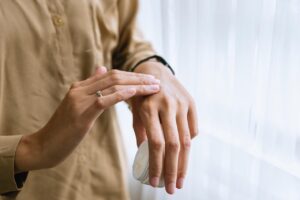
Dry around the nail folds and apply hand cream when the skin or nails begin to feel tight.
Put gloves on before dishes, cleaning, laundry, gardening, or prolonged contact with water and chemicals.
Moisturize the nails and surrounding skin, then leave rough cuticles alone instead of picking them.
Your daily routine does not need to be longer than this.
Apply moisturizer to both hands, massage a small amount into each nail and cuticle area, and check whether an edge needs to be filed later. Daily care should protect the nails, not reshape them.
What Healthy Nails Usually Look and Feel Like
Healthy nails do not have to be perfectly glossy, completely flat, or identical from finger to finger. Natural texture and small vertical ridges can be normal, especially as people get older.
A practical description of a healthy-looking nail is one that:
- Feels comfortably attached to the skin beneath it.
- Has no unexplained pain, warmth, bleeding, or swelling.
- Is relatively consistent in color for that individual.
- Does not have a new dark streak or rapidly changing mark.
- Has skin around it that is mostly intact and comfortable.
- Grows forward without repeated deep splitting or crumbling.
White spots caused by minor injury may move forward as the nail grows. Vertical ridges are also common. A sudden change in color, shape, thickness, attachment, or growth is different and deserves closer attention.
Your Weekly Nail-Care Session
Choose a day when you have approximately ten quiet minutes. You do not need to complete this routine on the same day every week, but spacing it out helps prevent over-filing and unnecessary cuticle work.
Remove old color without scraping
Use an appropriate remover for the product you are wearing. Press the pad against the polish briefly before wiping instead of repeatedly scrubbing the same area.
Inspect the bare nails
Look at the color, surface, free edge, attachment, and surrounding skin. Do not rush to cover an unexplained change with another manicure.
Trim only the length that interferes with daily life
Use clean, sharp clippers. A practical length is one that does not repeatedly bend, catch on fabric, or make ordinary tasks uncomfortable.
Shape the free edge gently
Use a fine nail file to smooth corners and snags. Stop when the edge feels comfortable rather than continuing until every nail looks mathematically identical.
Tidy only loose skin
Do not cut attached cuticle tissue. If a hangnail is clearly detached, clip only the loose end with a clean tool instead of pulling it.
Moisturize and decide whether to repolish
If the nails feel comfortable, you may continue with regular polish. If they feel thin, sore, overly flexible, or irritated, a quiet week without another manicure may be more useful.
How to Trim and Shape Without Chasing Perfection
The goal of trimming is to create an edge that suits your daily activities. Someone who types all day, handles boxes, plays an instrument, cares for children, or works with their hands may need a different length from someone who prefers longer decorative nails.
For fingernails, trim mostly straight across and soften the corners into a gentle curve. Use several controlled cuts rather than forcing the clipper through the entire nail at once.
Then use a fine file to correct only what needs correcting. Heavy pressure and repeated filing can leave the edge thinner than the rest of the nail.
| What you notice | What to do | What to avoid |
|---|---|---|
| A corner catches on clothing | Smooth that corner with a fine file | Filing the entire nail much shorter than necessary |
| The nail bends during daily tasks | Reduce the length slightly | Covering the problem with a very hard coating without changing the length |
| The surface has natural vertical ridges | Leave them alone or use a ridge-filling base coat | Buffing until the nail becomes thin and flat |
| The edge is peeling into layers | Shorten and smooth the loose tip carefully | Pulling the layer backward into attached nail |
| A sidewall feels painful | Stop cutting and monitor the area | Digging deeper with clippers or a pointed tool |
For a closer look at damaged edges, visit our guide to peeling nails and simple recovery habits.
Cuticle Care Should Be Mostly Moisturizing
The cuticle area helps protect the space where the nail grows. Removing it may create a temporarily bare nail plate, but it can also leave small openings in the surrounding skin.
A safer maintenance routine is usually:
- Wash and dry the hands.
- Apply moisturizer or a cuticle product.
- Allow dry skin to soften over several days.
- Clip only hangnails that are clearly loose.
- Avoid pushing skin that is cracked, painful, swollen, or resistant.
A useful test: If your cuticles look very clean immediately after care but feel sore the following day, the routine was too aggressive.
Our full Cuticle Care Guide explains how to handle dryness, hangnails, salon appointments, and irritated nail folds.
Water Protection Is Part of Nail Care
Nails are exposed to water during necessary activities such as bathing, washing hands, cooking, cleaning, and caring for a household. The goal is not to avoid water. It is to reduce prolonged wet work and restore moisture afterward.
Wear cotton-lined or comfortable household gloves for dishes, cleaning, and chemical exposure. Put them on before the task begins instead of waiting until the skin already feels dry.
After washing:
- Dry the fingertips and nail folds carefully.
- Remove moisture trapped beneath long free edges.
- Apply moisturizer when the hands feel tight.
- Remove damp gloves and let them dry before reusing them.
Clean does not mean aggressively scrubbed. Avoid digging beneath the nail with sharp objects. Keep the free edge clean using ordinary handwashing and a gentle nail brush when necessary.
Adjust the Routine to Your Real Life
A routine becomes more useful when it responds to the way your hands are actually used.
If you wash your hands frequently
Keep a non-irritating moisturizer near the sink. Focus on drying and moisturizing rather than adding more nail treatments.
If you type or use touchscreens all day
Choose a length that allows the fingertip—not the nail tip—to take most of the pressure.
If you work with boxes or tools
Keep edges short and smooth. Use proper tools to lift labels, open containers, and separate materials.
If you wear polish most weeks
Pay close attention to removal. Avoid peeling color, scraping the plate, or immediately applying another system to sore nails.
If you bite or pick
Keep the nails smooth enough that there is less texture to catch. Identify the situations in which the habit happens instead of relying only on willpower.
If your nails are already thin
Reduce length, skip surface buffing, use gloves during wet work, and avoid services that require further filing or forceful removal.
Polish Can Fit Into a Healthy Routine
Traditional nail polish is not automatically harmful. Problems often begin when the application is rushed, product remains on the skin, or the manicure is peeled and scraped away.
For a lower-stress regular-polish routine:
- Start with clean, dry nails.
- Apply thin layers rather than one heavy coat.
- Keep polish off the surrounding skin.
- Allow enough drying time before using your hands normally.
- Remove the polish with an appropriate remover instead of peeling it.
- Stop using products that cause burning, itching, swelling, or persistent redness.
The FDA advises consumers to read product labels, follow warnings, and use nail products in a well-ventilated area. Some nail products are flammable and should be kept away from heat, cigarettes, and open flames.
Gel, Acrylic, Dip Powder, and Press-On Nails
These systems require more than application supplies. A complete routine also includes safe removal, compatible products, clean tools, and enough time to avoid rushing.
Peeling or prying off hardened product can remove surface layers of the natural nail. Repeated filing may also leave the plate thinner and more sensitive.
Better habits
- Follow the manufacturer’s instructions.
- Keep uncured products away from the skin.
- Use the intended curing system.
- Purchase removal supplies before application.
- Stop when the nail or skin becomes painful.
Habits to avoid
- Peeling or biting product away.
- Scraping until the surface feels completely smooth.
- Applying over swollen or discolored nails.
- Mixing products without compatibility guidance.
- Using professional tools without understanding them.
For tool guidance, see our article about building a practical at-home manicure kit.
Do You Need Cuticle Oil, Nail Hardener, or Supplements?
Cuticle oil
It can be convenient for targeted moisturizing, but it is not essential. A hand cream or simple moisturizer that you already use consistently may be enough.
Nail hardener
A protective coating may help some weak nails, but stronger is not always better. If a product makes the nail feel too stiff, dry, or more likely to crack, stop using it.
Supplements
Do not assume that ordinary breakage proves a vitamin deficiency. Water exposure, product removal, picking, filing, and repeated impact are common explanations.
If several nails change along with fatigue, weakness, hair loss, skin symptoms, or another concern, discuss the complete pattern with a healthcare professional instead of choosing a supplement based only on nail appearance.
The Habits That Undo a Good Routine
- Using nails as tools: opening cans, lifting stickers, scraping surfaces, and separating objects repeatedly stress the free edge.
- Pulling hangnails: this may tear attached living skin and create a painful opening.
- Picking cuticles: repeated injury can damage the nail fold and increase irritation.
- Buffing every ridge: natural texture does not need to be removed from the nail plate.
- Peeling polish or gel: the product may take surface nail layers with it.
- Changing products constantly: it becomes harder to identify what is causing dryness or irritation.
- Ignoring pain: a manicure should not continue over an area that is swollen, bleeding, or increasingly tender.
When a nail keeps breaking in the same place: observe how that specific finger is used. The cause may be a repeated daily movement rather than a problem affecting every nail.
Use a Simple Nail Log Instead of Guessing
If your nails seem to be changing, record a few details once every two weeks. Checking them several times a day makes gradual progress difficult to see.
Quick nail check
Photograph the nails in similar lighting and without filters. This can help you notice whether a mark is growing forward, remaining unchanged, or spreading.
When Not to Continue With an At-Home Manicure
Some changes should be treated as health concerns rather than cosmetic inconveniences.
Pause nail products and seek professional advice if you notice:
- Pain, warmth, swelling, throbbing, or bleeding.
- Pus or fluid around or beneath a nail.
- A new or changing dark streak.
- A nail separating from the skin beneath it.
- Green, blue, black, or persistent yellow discoloration.
- Significant thickening, crumbling, pitting, or distortion.
- A nail that stops growing normally.
- Changes involving several nails along with other unexplained symptoms.
Nail color, shape, texture, thickness, and attachment can change because of injury, infection, skin conditions, medicines, or other health issues. Appearance alone is not enough to identify the cause reliably.
People with diabetes, poor circulation, reduced sensation, immune-system concerns, or difficulty healing should be especially cautious about cutting around the nails or treating an injury at home.
Your Routine at a Glance
| Frequency | What to do | What not to do |
|---|---|---|
| After washing | Dry around the nails and moisturize when needed | Pick softened skin or scrape beneath the nails |
| During wet work | Wear comfortable protective gloves | Leave damp gloves on for long periods |
| Daily | Check for snags and massage moisturizer into the nail area | File, buff, or push cuticles every day |
| Weekly or as needed | Trim, shape, and inspect the bare nails | Cut deeply into corners or attached cuticle tissue |
| Before polishing | Make sure the nail is comfortable, clean, and dry | Cover pain, swelling, lifting, or unusual color |
| Every two weeks | Compare progress in similar lighting | Expect a damaged nail to transform overnight |
Frequently Asked Questions
How often should I trim my fingernails?
Trim them when the length begins to interfere with daily activities, bend easily, or catch on objects. Some people need weekly trimming, while others can wait longer. Daily cutting and shaping are usually unnecessary.
Do I need to use cuticle oil every day?
No. Cuticle oil is one convenient option, but hand cream or another moisturizer may work well for everyday care. Consistency is more important than using a separate product for every part of the routine.
Should I let my nails breathe between manicures?
Nails do not breathe like skin or lungs. However, a break from polish or enhancements can make it easier to inspect the bare nail and avoid repeated remover, filing, scraping, or adhesive exposure when the nails feel damaged.
Is it normal to have vertical ridges?
Vertical ridges are common and may become more noticeable with age. Avoid trying to remove them completely through aggressive buffing. New horizontal grooves, color changes, pain, or other symptoms deserve professional advice.
How long does it take for damaged fingernails to improve?
Improvement is gradual because the damaged section must grow toward the tip before it can be trimmed away. Protecting new growth is more useful than trying to erase old damage through heavy buffing.
Final Takeaway
The best nail-care routine is the one you can repeat without damaging the nail in the process.
Most days, that means drying your hands carefully, applying moisturizer, protecting the nails during wet or chemical work, and resisting the urge to pick at every rough edge.
Once a week—or only when necessary—trim the length, smooth snags, inspect the bare nails, and clip clearly loose hangnails. Avoid turning maintenance into a deep cuticle or buffing session.
Healthy-looking nails are built gradually. When a nail becomes painful, swollen, discolored, distorted, or detached, stop trying to improve its appearance and ask a qualified healthcare professional to evaluate the change.
Editorial note: This article provides general educational information about cosmetic nail care. It does not replace medical diagnosis or treatment. DolfiNails does not currently use affiliate links in this guide.
Sources and Further Reading
- American Academy of Dermatology — Dermatologists’ Tips for Healthy Nails
- Mayo Clinic — Fingernails: Do’s and Don’ts for Healthy Nails
- U.S. Food and Drug Administration — Nail Care Products
- MedlinePlus — Nail Abnormalities
Last editorial review: July 17, 2026

The DolfiNails Editorial Team creates practical and carefully researched content about nail care, manicure techniques, nail art, tools, and beauty products. Each article is reviewed for clarity, usefulness, and reader safety to help readers make better-informed decisions about their nail care routines.